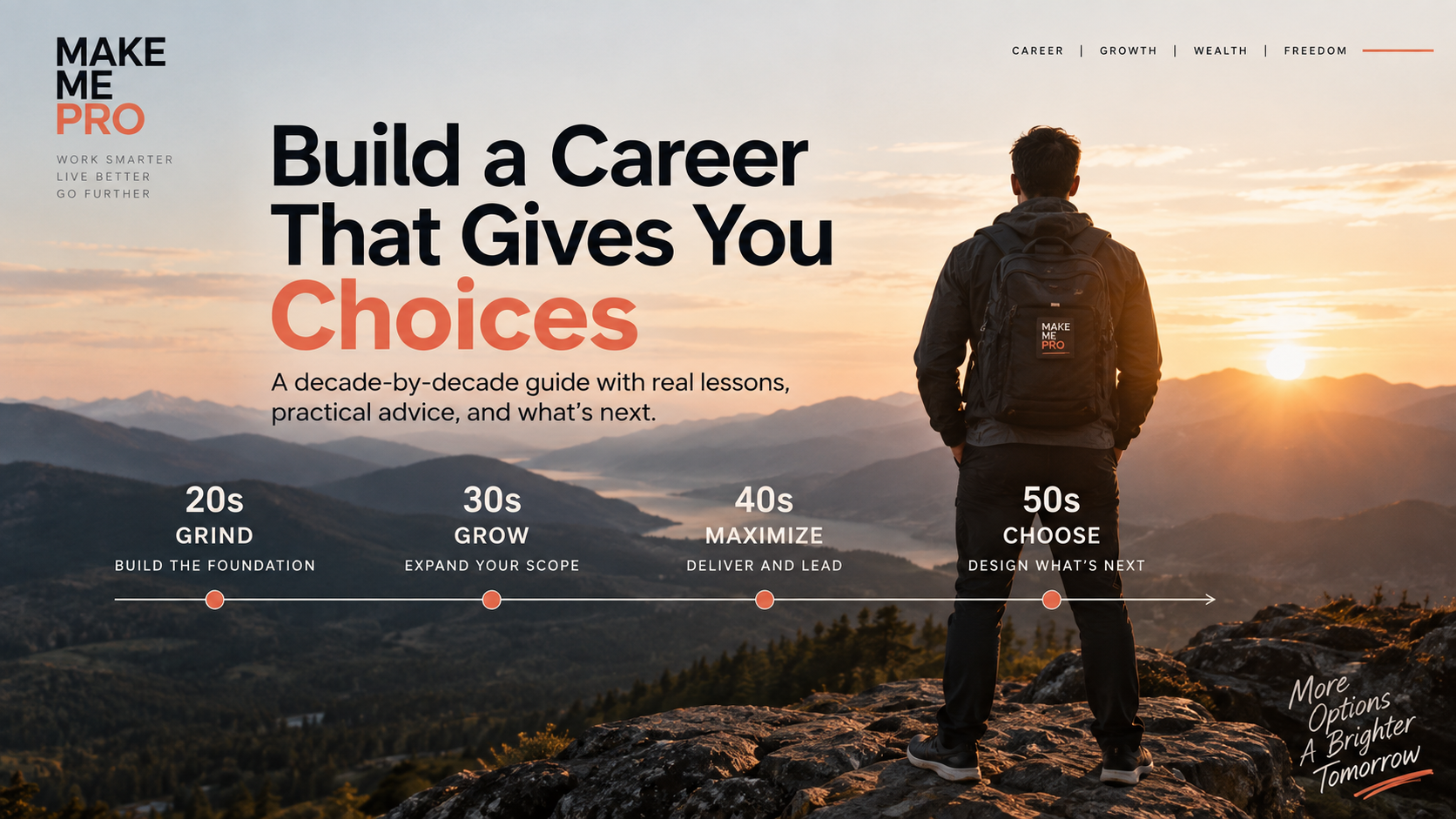
I think about career progression in decades. I still want to grow, but what I want from work is changing as my life changes.
The simple version of the framework is: Grind → Grow → Maximize → Choose.
I don’t mean that everyone should follow the same timeline. Careers are messy. Life is messier. Some people start over at 45. Some people hit their stride at 25. Some people never want the corner office.
The point is to think about what you are trying to get from each season, and whether the way you are working now is creating more choices for the future.
Your 20s: Grind and build the foundation
When your responsibilities allow it, put in the work. Take on assignments that stretch you. Spend the extra hours developing skills and pursue credentials that will help you get where you want to go.
I spent my 20s building my career at UnitedHealth Group, taking on increasing responsibility. Alongside work, I earned my MBA and certifications including my PMP, CSM, and Six Sigma. I went deeper into software engineering and kept finding opportunities to learn through the work itself.
I was trying to build a base I could use later: skills, experience, credibility, relationships and proof that I could take on more.
There is a season where extra effort compounds. If you have the capacity for it, your 20s can be a good time to take advantage of that.
Your 30s: Grow your scope and find your balance
Use the foundation you’ve built to take on bigger problems. Keep learning, while becoming more selective about the opportunities you pursue.
In my 30s, I landed my dream job at Amazon Web Services. I developed expertise helping organizations understand how to use the cloud and put it to work. Now I’m back in health insurance, leading work to deploy AI solutions. It’s an exciting opportunity to apply what I’ve learned while challenging myself in a new area.
I’ve also become more conscious of how a role fits my life. With a growing family, I want work that excites me and leaves room to be present at home.
Broader scope shouldn’t automatically mean longer hours. Part of growing is learning to delegate and deliver results without having to be involved in every detail.
The goal starts shifting from proving you can work hard to proving you can create more value with the experience you have built.
Your 40s: Maximize your value and decide your pace
This is where I want my experience to translate into consistently strong performance and compensation that reflects it.
I still have goals I want to reach in my corporate career. In my 40s, I plan to keep mastering execution and take on broader responsibility. I want to get better at turning ambitious ideas into work that actually gets delivered.
For someone else, this stage might mean finding a role they do exceptionally well and settling into a sustainable pace. There’s nothing wrong with finding your version of cruise control.
You don’t have to pursue every promotion just because it’s available.
Keep maintaining the foundation that gives you those options. Stay current in your field and continue learning, even when you feel comfortable in your role.
Your 50s: Choose the work you want
My 50s are still an open question. We’ll see where the corporate ladder takes me. A bigger leadership role might still be appealing. Make Me Pro could become my main work, or consulting and Cirillo Vineyards could take up more of my time and interest.
I’d like to reach that stage with more freedom to decide what I take on. Ideally, paid work becomes optional. That’s a goal I need to plan toward, rather than something I expect to happen at a certain age.
For some people, this could be the final push toward the C-suite. For others, it could be the point when a business they’ve been building on the side becomes their full-time focus.
The aim is to have choices you’ve prepared for.
Carry the foundation forward
The decades are not the point. The compounding is.
The skills you build early can create better opportunities later. Better opportunities can create more income, experience and flexibility. If you keep using those gains well, eventually you can have more say over what work you take on and how much space it gets in your life.
I’ve lived the early part of this framework. The rest is what I’m working toward.
The question I want to keep asking is: Is the way I’m working now giving me more choices later?